
Discrete pads, not the whole face
A full-face rest fights warp. A few intended pads give the part a stable seat.
Support surfaces
A support surface is where the part sits or mates. Use discrete pads instead of a full flat face that will rock after warp. DFM review comments on your CAD before quoting.
Design guideline
A support surface is where the molded part actually rests or mates. A full flat face is a warp risk, not a seating plan.
Plan a few discrete pads instead of asking the whole bottom skin to sit flat. Large faces bow after cooling. See warpage for why, and uniform wall thickness when thickness steps drive that bow. DFM review comments on your CAD, resin, and mate faces.
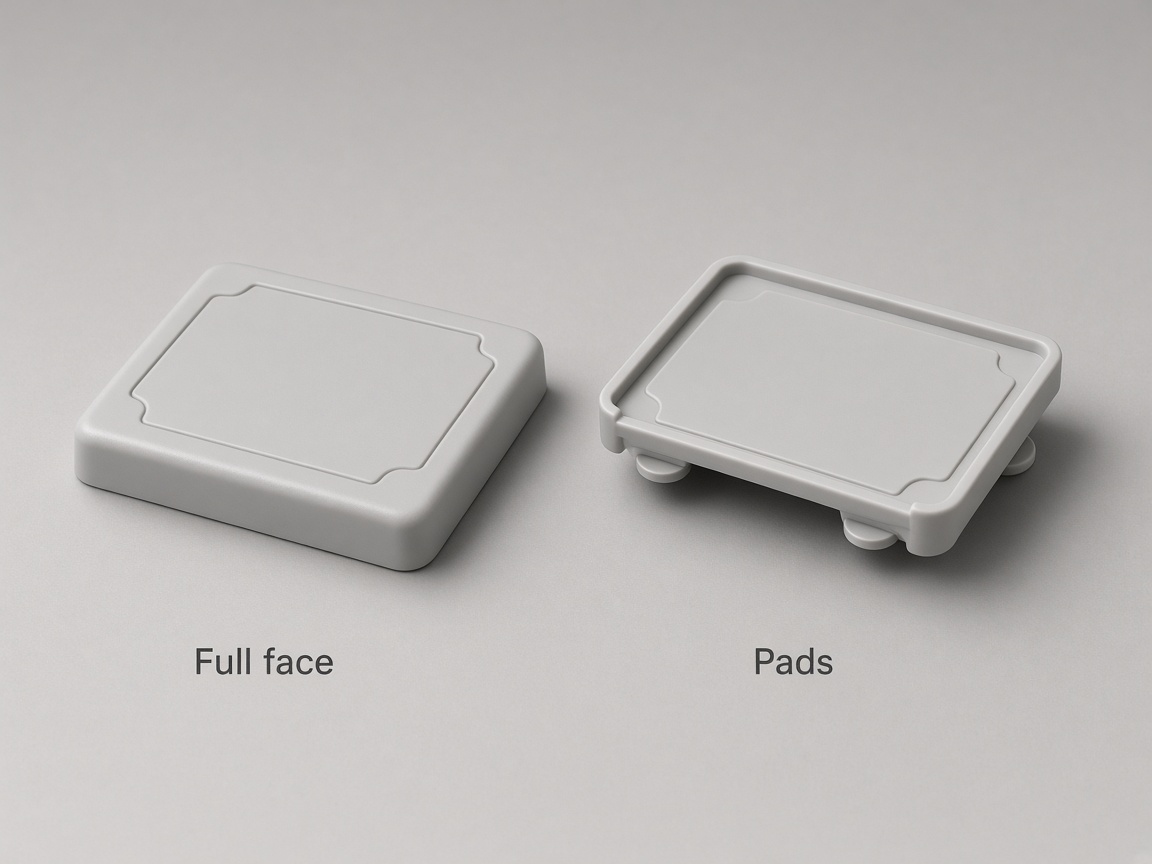
This page is not the rib , gusset , or boss rule. Those features add stiffness or fastening. Support pads are the rest points. GD&T for molded parts owns inspection datums, which may share a pad when the seating plan and the inspection plan match. The design guide hub lists every topic.
Roles
Stay here for rest and mate pads. Open a sibling for stiffness, datums, or the CAD check.
| Page | Use it for |
|---|---|
| Support surfaces (this page) | Discrete pads the part sits or mates on |
| Wall thickness | Nominal wall that still drives warp on a large face |
| Uniform wall thickness | Transitions that bow a seating face |
| Rib design | Long stiffeners. Not the rest pads |
| Gusset design | Triangular braces. Not the seating plan |
| Boss design | Screw posts that may sit near a pad |
| Draft angle | Draft on pad sides that pull with the steel |
| GD&T for molded parts | Inspection datums, which may share a pad |
| Warpage | Why a full face rocks after cooling |
| DFM review | CAD check of seating faces before quoting |
Checks
Qualitative checks. No pad count or height on this page is a NetProto specification.
Discrete pads, not the whole face
A full-face rest fights warp. A few intended pads give the part a stable seat.
Keep pads from becoming thick islands
A pad that matches a thick wall can sink the opposite cosmetic face. Size it from the nominal wall.
Draft on pad sides
Vertical pad walls that pull with the core or cavity need draft. Texture usually needs more draft per side.
Seating plan versus inspection plan
Say which pads carry load or mate, and which faces are datums. They do not have to be the same set.
Decision
Wrong: sit the part on the whole bottom skin. Right: a few pads, draft, and notes on mates.
RFQ
The quote can start from CAD alone. These notes make the DFM pass specific.
Which faces are rest or mate pads
Which faces are cosmetic and must not print sink
Draft notes on pad sides, if you already have a target
Which pads also serve as inspection datums
Resin or family, especially if warp is already a concern
Clearance under the part for ejection and handling
Related
This page owns the seating plan. Open a sibling for stiffness, datums, or the CAD check.
How NetProto checks seating faces on your CAD before quoting.
DFM reviewRule index for every injection molding design topic.
Design guide hubWhy large faces bow and rock after cooling.
WarpageFAQ
A support surface is the face or set of pads the part actually sits or mates on. It is not the whole bottom skin, and it is not a rib or gusset. This page owns that seating plan.
A large flat face rarely stays flat after molding. Warp, sink, and uneven cooling lift one edge and rock the part. Discrete pads give the part a few intended rest points instead of a face that fights the table.
NetProto does not publish a pad count or height. Industry practice often uses a small number of discrete pads so the part cannot rock. Upload CAD for DFM review of your seating faces.
A rib stiffens a wall. A gusset braces a tall wall or boss. A boss is a fastening post. Support surfaces are where the part rests or mates. Open those siblings for the feature; stay here for the seating plan.
Not always. A datum is an inspection reference. A support pad is a physical rest or mate. They can share a face when the seating plan and the inspection plan match. The GD&T page owns datums.
Yes when the pad sides pull with the core or cavity. Texture and deeper pads usually need more draft per side. Open the draft angle page for that rule. DFM review comments on your CAD.
Next step
Share geometry, resin, mate faces, and which pads carry load so review can check the seating plan before quoting.