
Acetal (POM)
- Stable length in humid environments
- Good for precision stack height
- Lower impact than nylon
Molded part guide: spacers
A spacer sets distance between two parts on a bolt or shaft. Molded spacers are cheap at volume, but a tall thin tube warps and a tight clearance hole binds when shrink is ignored.
Distance
Spacers show up in valve stacks, motor mounts, and electronics assemblies. They can be plain tubes, shouldered rings, or square blocks with a through hole. The stack height is the sum of spacer length plus mate part thicknesses plus bolt head clearance.
Through holes are clearance for the screw shank, not thread forming. If the hole is too tight at minimum plastic, assembly binds. If too loose, the stack rocks.
Shoulder spacers locate a bearing or a pulley on a shaft with one molded step. The shoulder face must be square to the bore so the seated part does not tilt.
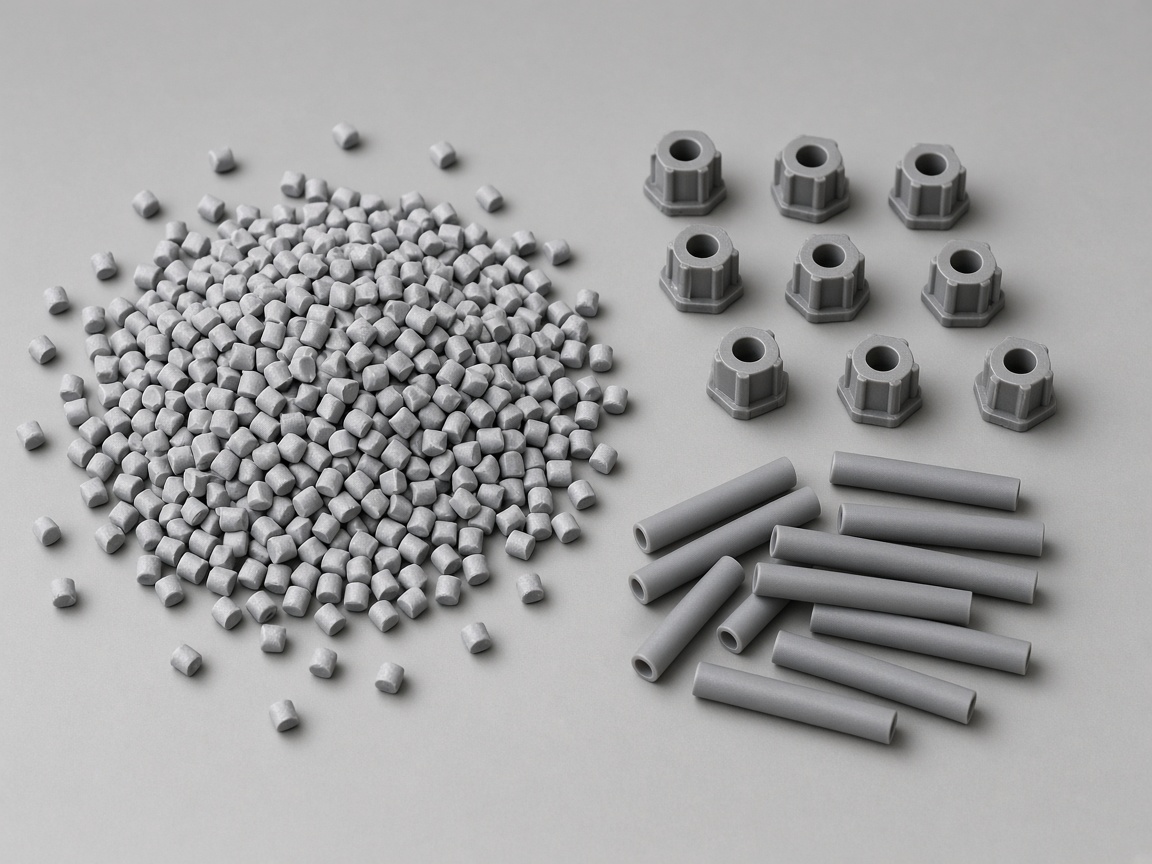
Forms
| Shape | Use | Molding note |
|---|---|---|
| Plain tube | Bolt stack height | Core supported for length; watch end flatness |
| Shoulder ring | Axial location on shaft | Step must be moldable without collapsing core |
| Square block spacer | Anti-rotation in stack | Corner radii reduce stress and help fill |
Service tiers
Spacer focus: stack height and through-hole clearance. Upload CAD with the stack height in notes when the model omits it.
| Tier | Environment | What matters most | Typical molded route | Quote path |
|---|---|---|---|---|
| 1 Tubular spacer | Bolt through clearance | Height stack and ID/OD | PA or PC tube | Instant quote; field Nylon or PC |
| 2 Shoulder spacer | Stepped OD for assembly | Shoulder concentricity | POM or PA turned-style mold | Instant quote; note shoulder dims in drawing |
| 3 Insulating spacer | Keep metal parts separated | Creepage and cracking | PC or unfilled PA | Instant quote; note clearance need qualitatively |
| 4 High temperature | Near hot component | Creep on stack height | GF PA or PBT | Full RFQ; note temperature range |
| 5 Cosmetic shoulder | Visible in assembly | Sink on thick sections | PC/ABS; core out thick zones in CAD | Upload CAD; expect sink review |
Materials
One family per spacer line item. Put the stack height in comments.
| Family | Typical use on this part type | Notes for instant quote |
|---|---|---|
| PA (nylon) | General tubular spacers | Field Nylon; most common |
| POM (acetal) | Precision length spacers | Field POM; low moisture sensitivity |
| PC | Insulating and clear spacers | Field PC; watch stress from tight fits |
| ABS | Indoor low-cost spacers | Field ABS |
| PP | Light-duty non-critical stacks | Field PP; limited load capacity |
Resin
Drawing
Overall length and shoulder heights if any
Through hole diameter and clearance class for the fastener
Stack tolerance budget with mate parts
Load: compression only or side load on the tube
Flatness needs on end faces
Quantity and whether multiples fit in one mold
Keep reading
Board height posts.
StandoffsSliding sleeves, not stack rings.
BushingsStack height at extremes.
Tolerance stack upStable spacer resin.
Acetal (POM)Tall tubes bowing.
WarpageSpacers in bolted plates.
Mounting bracketsLength and hole callouts.
Standard tolerancesShoulder spacers on shafts.
GearsEvery part-type guide.
Molded parts libraryFAQ
Family molds are possible when lengths share the same bore and OD system. Each length is a separate cavity and adds tool cost.
Check length at tolerance extremes plus mate parts. Acetal spacers often reduce humidity drift compared with nylon.
Internal threads are possible on larger bores with unscrewing cores. Small clearance holes stay smooth for shank clearance.
Yes when visibility matters. Clear resins need even wall and careful gate choice to avoid flow marks in the bore.
Next step
Upload CAD with length, hole, and mate parts in the stack. DFM feedback covers core support and end face flatness.