
SPI polish grades
- Best when gloss or haze is the buyer language
- Pairs with Class-A or optical faces
- See the SPI surface finish chart for the grade families
Decision guide
SPI names polish families. VDI names a spark or matte scale. MoldTech names catalog textures. Pick the system that matches the face, then write that code on the drawing.
Decision guide
This page helps you pick a callout system. It does not replace the SPI chart or the texture hub.
SPI finish grades describe mold polish from high-gloss diamond finishes through stone and grit textures. Use them when the face is about gloss, haze, or a standard polish step.
VDI texture grades describe a spark-eroded or matte scale used on many European drawings. Use them when the buyer already thinks in VDI numbers.
MoldTech and similar catalog textures name a specific grain pattern. Use them when the look must match a swatch, not only a gloss family.
Do not invent a conversion table on this page. If two systems must appear on one part, name the system per face and attach the vendor plaque or catalog page.
When to use which
The systems overlap in conversation and diverge on the drawing. Call the system, then the code.
Visual reference
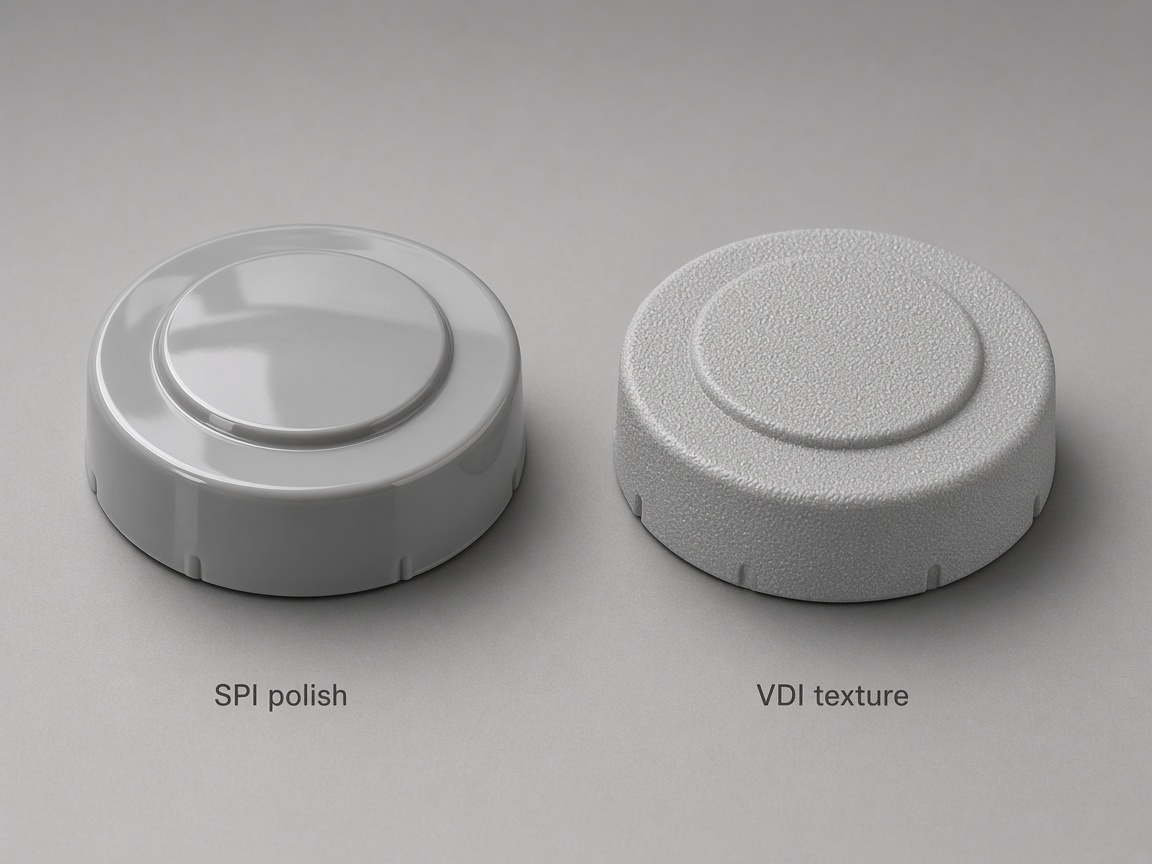
SPI polish vs VDI texture
Same lid geometry. Gloss polish compared with a matte VDI texture.
Callouts
Use this table to pick one callout system per face. No unofficial VDI-to-SPI number map. Use the SPI chart and texture hub for grade lookup.
| Need on the face | Preferred system | What to attach |
|---|---|---|
| High gloss or optical clarity | SPI polish grade | The SPI grade and the viewing distance |
| Matte hide for sink or pin witness | VDI scale or a catalog texture | The VDI code or MoldTech number plus a plaque photo |
| Exact grain match to an existing part | MoldTech or the OEM catalog | The catalog page and a physical swatch if you have one |
| Mixed faces on one part | One system per face | A cosmetic map that names SPI, VDI, or MoldTech by zone |
RFQ
Finish is a face-level specification. A single global note is how zones get polished the wrong way.
Mark A-side and hidden faces before you pick a finish system.
Write SPI, VDI, or MoldTech explicitly next to each zone.
Attach a plaque, catalog page, or photo when the grain must match.
Do not convert VDI to SPI with an unofficial chart on the RFQ.
Ask DFM whether the texture needs extra draft on those faces. Add draft notes on the drawing before steel is released.
Continue exploring
Decision guides and deeper process pages.
All comparison guides.
Compare hubGrade families from high gloss through grit textures.
SPI surface finish chartMoldTech, VDI, and when texture is the right hide.
Injection molding texturesOne SPI grade explained for drawing notes.
SPI B1 glossaryMark show faces before you pick a finish system.
Cosmetic face (A-side) vs hidden facesTexture can hide pin witness. Still mark keep-outs.
Ejector pin marks on cosmetic partsHow A1 is called out when the face is about gloss.
SPI A1 finish for high-gloss facesFAQ
No. VDI is a numbered texture scale. MoldTech is a catalog of named grains. A drawing should pick one system per face and attach the plaque or catalog page if the look must match.
Avoid dual codes on one face. Inspectors will not know which plaque wins. Pick the system your quality team already uses, then keep the other system off that zone.
Texture and polish answer different jobs. Texture hides or adds grip. Polish sets gloss. If a face needs both, split the zone or say which requirement is primary.
Use the SPI surface finish chart for the grade families and the textures page for MoldTech and VDI context. This compare page only chooses which language to write.
There is no official conversion between SPI and VDI. Each system measures a different thing: a polish step versus a spark or matte scale. Do not put an unofficial conversion chart on the drawing. Pick one system per face and attach the plaque or catalog page.
Deeper grains often need more draft to release cleanly. Ask DFM to flag the selected MoldTech grain on those faces. Put draft notes on the drawing before steel is released.
Next step
If you are unsure which system to write, upload CAD anyway so DFM can flag polish versus texture zones. Name SPI, VDI, or MoldTech per face when you know them. If you already have a texture plaque from a previous program, attach it with the CAD so reviewers can see the grain you already approved.