Two-Shot vs Sequential Overmold: Which Route to Quote First
What Is Sequential Overmold Versus Two-Shot?
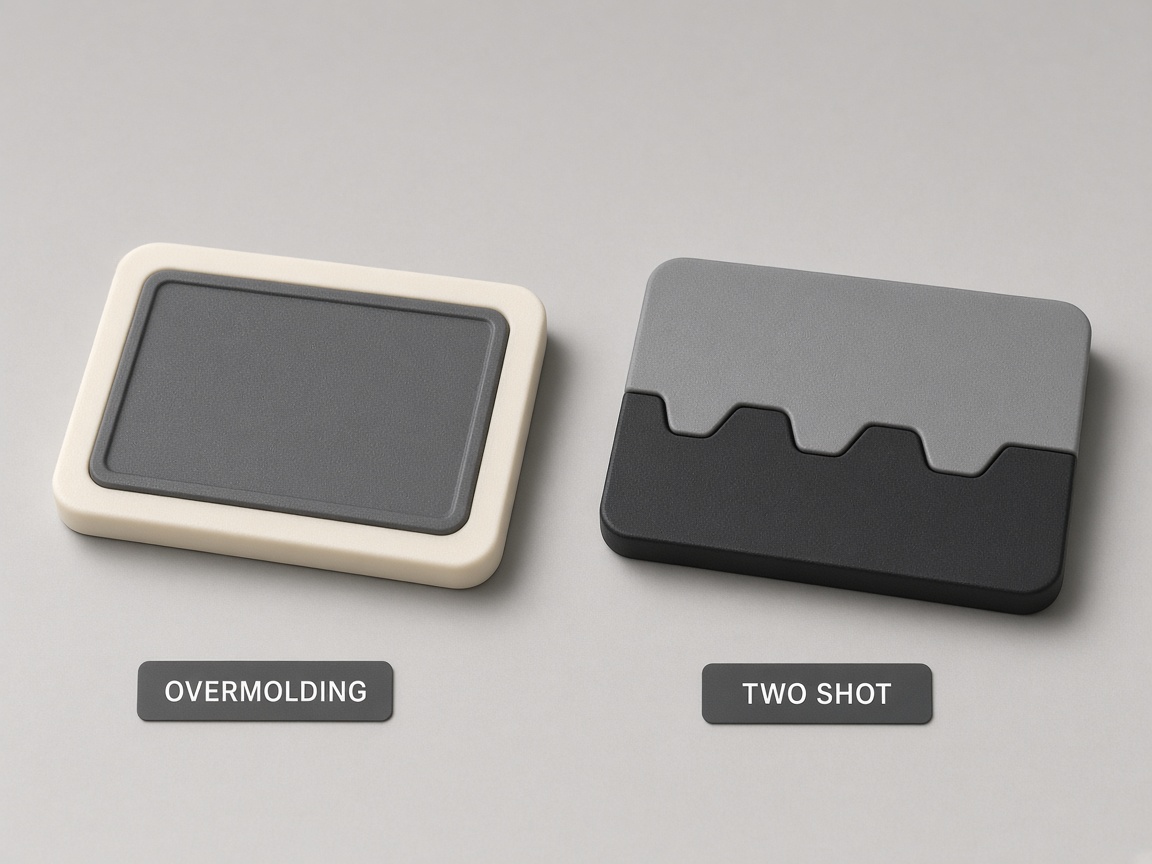
Two shot injection molding places a substrate and a second material in one tool family. A rotary platen or a transfer action keeps the first shot registered so the skin can fill against it in the same press. Sequential overmold molds the substrate first, then loads that part into another cavity or a second tool for the skin. This page decides which RFQ to send first. The pairwise table stays on the compare page.
Engineers and program owners search two shot injection molding when the second shot is still open. They need a process name and a quote order. The wrong first RFQ locks a tool layout before the skin solid, the pair, or the bond job is ready. The right first RFQ matches the production route you expect to keep.
Sequential overmold is two molding events. The substrate leaves the first tool, then sits in a later cavity while the skin fills to a planned shutoff. Handling between shots is the feature, not a defect. You can revise the skin solid, change the skin family, or add a mechanical lock without recutting a rotary two-shot stack. The tradeoff is a second load step on every part, plus a second shutoff that must stay clean.
Two-shot keeps both shots in one tool family. The first shot never leaves the press as a loose part. Shutoff between the two materials is steel to steel in that stack. When the skin geometry, the pair, and the shot volumes are frozen, this route removes the second handling step. When any of those three is still moving, a two-shot quote is usually premature.
Do not treat the two names as quality tiers. Sequential overmold is not a cheaper sample trick. Two-shot is not automatically the production upgrade. Both routes can make a bonded grip, a seal, or a two-color housing. The difference that belongs on the first RFQ is freeze state: what can still move, and what you already proved.
A program owner often wants the two-shot quote first because the brochure photo is a two-shot handle. An engineer often wants sequential first because the skin still moves. Both can be right. The checklist below is the tie-break: freeze state, pair, shutoff, and what T1 must prove.
Use overmolding vs two shot molding for the tooling, bond, and volume table. This article only answers which quote to open first.
Key Facts
- Quote the route that matches how you will make production parts, not the fastest sample story.
- If the skin material or bond is still open, a sequential overmold quote is usually easier to revise.
- If the shutoff and volumes are frozen, a two-shot quote avoids a second handling step later.
- The material pair still matters. See LSR vs TPE overmolding for the skin family.
- Cycle time and cavitation stay with the molder after DFM. They are not RFQ defaults you copy from a blog.
- Name the bond job on the RFQ: peel, seal, grip, or a mechanical lock. Do not leave good adhesion as the only note.
- Mark shutoff edges and cosmetic faces on both shots. Missing split lines are a common DFM flag.
- A prototype two-shot sample from another shop is comparison data. Attach what it taught you, then quote the production route you intend to keep.
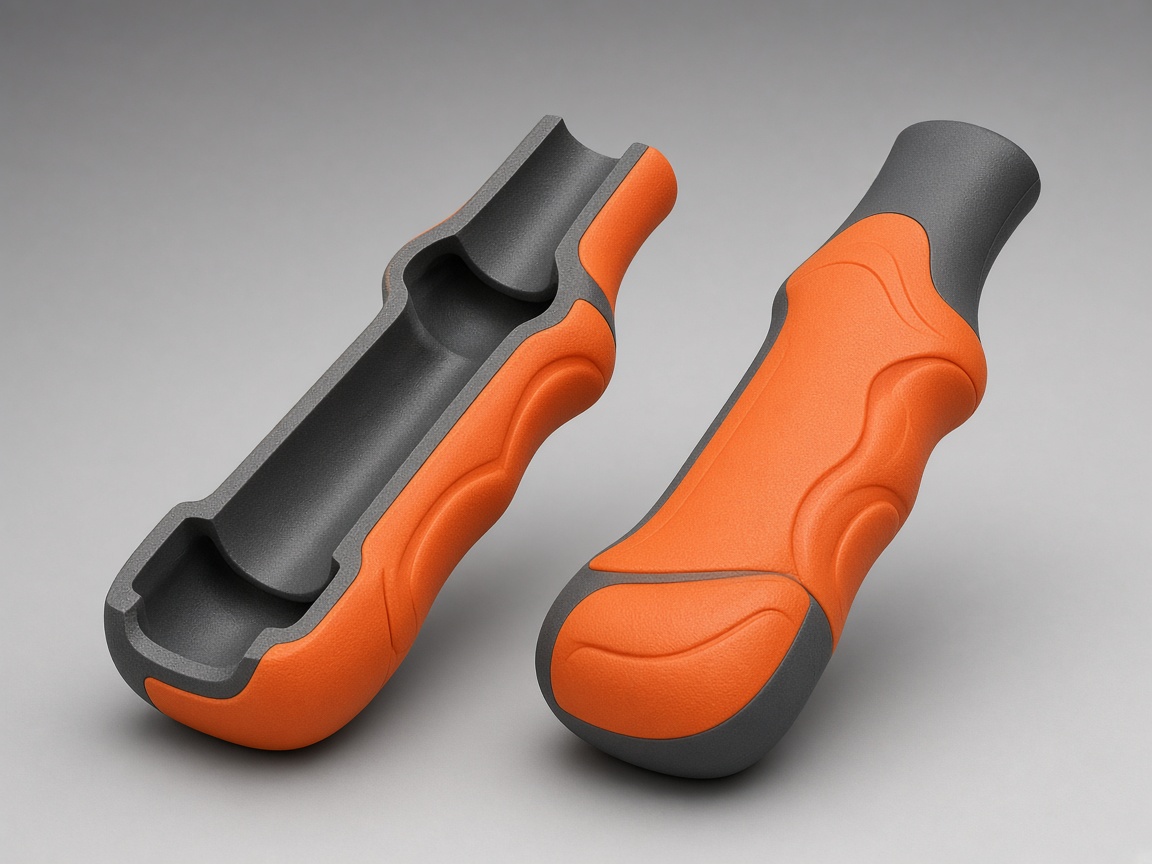
A two-shot handle with a TPE skin is the picture most teams bring to a kickoff. The picture does not choose the RFQ. Frozen shutoff and a frozen pair point toward two-shot. An open pair or a moving grip solid point toward sequential overmold first.
Frozen means you can point to a closed shutoff edge on CAD, name both resins or a locked job, and state that production will keep that route. Open means the skin still changes after each design review, the pair is still TPE versus LSR, or the only proof you have is a looks-like sample from another shop. Write the freeze state in plain language. DFM flags gaps. It does not invent a freeze for you.
Related Process Guides
The compare page owns the pairwise table. Read overmolding vs two shot molding for tooling and bond tradeoffs. For process scope, bond jobs, and what an overmold package includes, see overmolding services. For the skin family, stay on the LSR versus TPE article linked above. This page stays on quote order.
If your question is how a rotary platen moves the first shot, or how to draft a two-shot shutoff, those process and design guides are the home for that detail. If your question is which file to upload this week, stay here and run the checklist below. Do not paste the compare table into the RFQ. A table of general tradeoffs does not replace a shutoff edge on your CAD.
Which RFQ to Send First
Use these six steps. Write the answers on the RFQ, not only in email.
-
State whether the skin geometry is frozen. If the grip, seal, or window still changes every design review, say so. A sequential overmold quote is usually the first send in that state. Write two-shot required only when the skin solid is locked and a prior tool already proved that route. A surface that still moves after industrial-design review is not frozen, even if the substrate is released.
-
Name the substrate and skin resins, or the grip or seal job if grades are open. A pair such as PC plus TPE is enough to start. If the skin is still soft touch or gasket, write the job and the environment (oil, skin contact, outdoor UV) instead of inventing a grade. DFM flags an open pair. It does not pick the resin for you. If you already rejected a pair on a previous sample, say why (peel, bloom, stain, or a failed seal).
-
Mark shutoff edges and cosmetic faces on both shots. The split where skin meets substrate is where flash, witness, and peel start. Mark the show face, the gate keep-out, and any face that cannot take a load-line witness. If you only have a surface body for the skin, still sketch the shutoff. A clean render with no split named is a common delay.
-
Write sequential overmold to be considered if the second shot may move. That sentence tells the quote to keep the skin revisable. It is not a request for a second production process. It is a freeze-state note. Use it when you expect T1 to teach the pair, then decide whether a later two-shot stack is worth cutting.
-
Write two-shot required only if a prior tool already proved that route. A look-alike sample is not proof. Proof is a shutoff that filled clean, a bond test you already named, and a production plan that keeps both shots in one tool family. If the prior tool was a temporary stack at another shop, treat those results as comparison notes. Quote the production route, not the temporary stack.
-
Upload both solids through the instant quote platform. The substrate solid plus the skin solid (or skin surface) is the minimum. One combined solid with no split named is a common delay. If the skin is still a surface body, say so in the notes so DFM does not read it as a finished offset.
Skip a step and the first quote usually comes back with a DFM flag instead of a clean route. That is still useful. It is slower than writing the freeze state up front. If you are torn between the two routes, send sequential overmold first and state that two-shot is the intended production path if T1 proves the pair. That keeps the first steel revisable without hiding the long-term plan.
What T1 Must Prove
T1 is not a photo of a fused-looking split. Write the proof in your own test language before steel is cut. The molder can match a named test. The molder cannot guess which peel, leak, or cosmetic rule is the gate.
Bond or mechanical lock. Name peel, seal, grip, or a lock feature you can inspect. If the job is a gasket, say what leak or compression check you will run. If the job is a grip, say whether a peel strip or a field abrasion check is the gate. Looks stuck is not a gate. If you use a mechanical lock (dovetail, hole, groove), mark it on the substrate so T1 can show fill into that feature, not only a chemical bond story.
Flash at the material split. Call out the shutoff edge as a T1 photo face. Say whether a hairline witness is allowed on a hidden edge and forbidden on a show face. Sequential parts see two shutoffs. Two-shot parts see the steel split in one tool. Both still need the same photo. Do not wait until a later sample lot to decide that flash on a logo face is a fail.
Color or texture on the show face. Name the show face and the finish system. A grip that feels right but shows the wrong grain still fails cosmetics. A two-shot color line that walks onto a logo face is a T1 fail even when the bond holds. If the skin and substrate are the same family in two colors, the T1 gate is the color line, not peel.
Add photos of the split from the show side and the hidden side. Add the test you named, not a generic adhesion OK note. If you already ran a prototype two-shot sample elsewhere, attach what that sample taught you (peel, flash, warp) as comparison notes. Those notes help DFM flag the same risk on the production quote. They do not create a separate prototype product line on the RFQ.
Leave press settings, rotary timing, and transfer motion with the molder. Your T1 list is the part: bond, flash, and the show face. If a test needs a fixture or a fluid, say so on the RFQ so the first articles are not judged by a handshake in the conference room.