Skip to content
NetProto

Glossary

What Is an SPI D2 Finish? Injection Molding Explained

SPI D2 is medium bead blast on cavity-side utility land, not a retail gloss finish for customer-facing shells.

Engineering note

SPI D2 is medium bead blast texture on mold steel, not a coating

D grades target uniform matte utility surfaces where polish cost and defect visibility are unnecessary.

D2 uses dry bead blast on cavity steel for consistent medium matte appearance on the part.

Blast hides minor tooling marks and scratches better than polished A or B bands.

D2 is rarely the right default for Class A exteriors unless styling calls for uniform blasted matte.

Reference

SPI D2 vs nearby grades (typical mold steel targets)

D bands describe blast texture on steel, not a fixed part Ra in every shop. Ra values shown are typical mold steel targets. Final acceptance is by visual match against an approved T0 sample or texture plaque, not Ra alone.

FinishMethodGlossRa (approx.)Typical use
SPI C3320 grit stoneCoarse matte0.50 to 0.70 umHeavy stone hide on non cosmetic faces
SPI D2Medium dry bead blastUniform matteBlast texture (shop dependent)Internal covers, utility brackets, paint prep
SPI D3Heavy dry bead blastCoarse matteBlast texture (shop dependent)Hidden functional surfaces

Selection

When SPI D2 is a strong choice

D2 fits surfaces that must look uniform but are not retail gloss faces.

  • Underside brackets, internal covers, and back faces not seen in normal use

  • Large hidden flats where gloss would amplify sink and flow marks unnecessarily

  • Parts destined for paint or powder where blast texture is acceptable under the coating system

  • Tooling refresh on utility cavities where polish would add cost without user benefit

Selection

When to avoid SPI D2 or pick another grade

Use C stone or B polish when appearance spec is stricter than utility blast.

Avoid D2 on customer facing exteriors

  • Retail visible housings that expect semi gloss or high gloss under store lighting
  • Touch surfaces that need defined MoldTech or VDI grip instead of random blast
  • Optical or branded faces that belong on A or B polish with cosmetic acceptance
  • Regulated device faces where blast media embedment needs extra process review beyond SPI label

Pick the right utility matte

  • C1 or C2 when a stone matte exterior still needs low glare without blast speckle
  • D1 for lighter dry bead blast when D2 reads too coarse on large areas that still need uniform matte
  • D2 for medium blast on internal covers, paint prep, and utility flats (this page)
  • D3 for heavier blast on deep hidden pockets where maximum hide and lowest polish cost win
  • Use the SPI finish chart when the RFQ must name D1, D2, or D3 on the same part

DFM

How D2 changes mold and part risk

Blast is forgiving on hide but still affects pull, paint, and local repair.

  • Draft and ejection must account for matte pull. Blast is not zero drag on deep ribs.
  • Local weld or damage repair may need re blast to match surrounding D2 texture.
  • Paint adhesion often works on D2 but needs defined prep and chemistry in the RFQ.
  • Mixed D2 with polished faces needs shutoffs so blast does not bleed into gloss land.
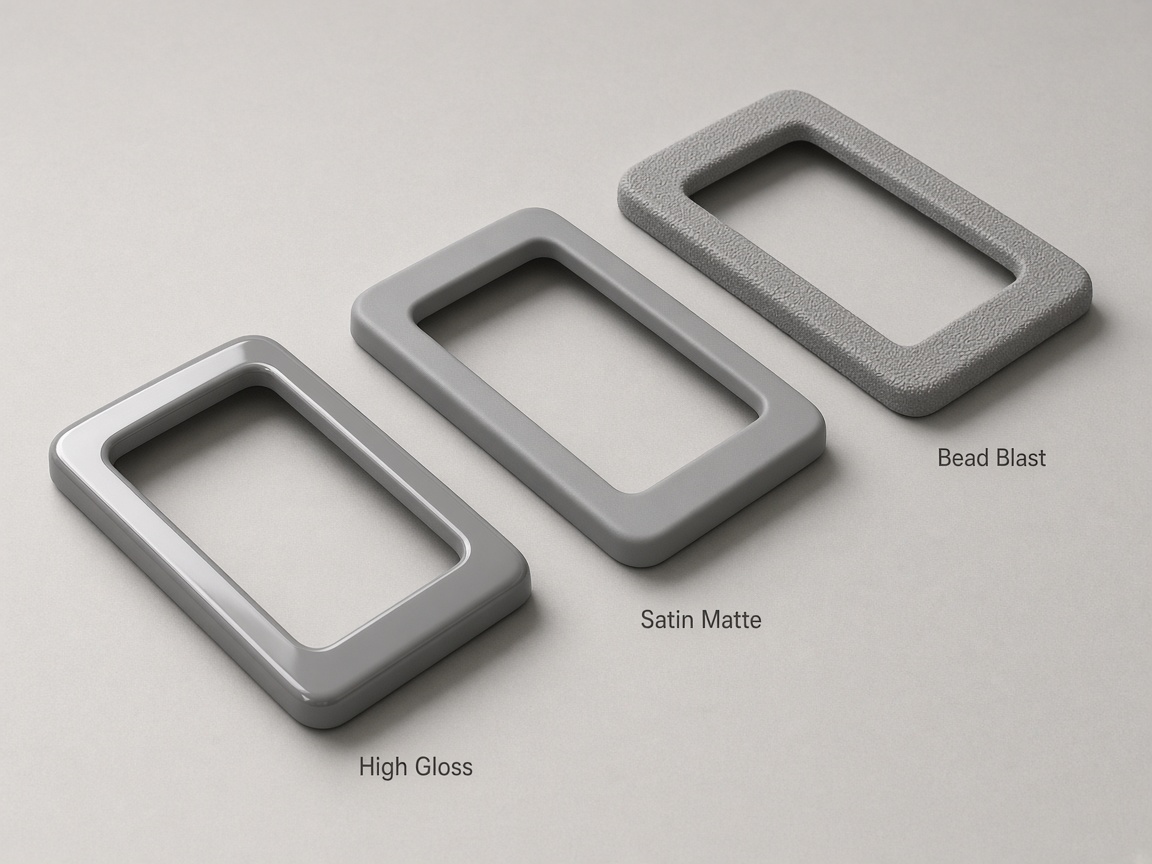
Three gray appliance bezels compared: High Gloss, Satin Matte and Bead Blast finishes

Materials

Resin and color effects on D2 appearance

Blast uniformizes steel texture; resin still controls shrink show and color depth.

  • Filled resins may show more shrink texture on large D2 flats than unfilled grades.

  • Dark colors hide utility surface defects better than light colors on blasted faces.

  • Soft elastomers may look dull on D2 without affecting function on hidden parts.

  • Glass filled resins may show more visible fiber protrusion on D2 than on C stone. Test before specifying D2 on glass filled nylon parts.

Drawings

How to call out SPI D2 on CAD and PDF

Mark hidden and utility faces so polish scope is not assumed tool wide.

  • Label D2 faces on CAD or PMI and note which exteriors remain on B, C, or A bands

  • State whether D2 is final appearance or under paint or coating

  • Define acceptable blast uniformity and repair rules for T1 on utility surfaces

  • Reference bead blast spoke for media and masking notes when mixed with glossy cavities

  • Link SPI chart when D band appears alongside C stone on the same part

  • State whether signoff uses T0 samples, blast uniformity limits, or paint drawdown over D2

Go deeper

Where this term connects

Each link is a different angle on the same program, not a duplicate definition.

Visual reference

Photos from molding and tooling programs

Images are selected from the NetProto Forge media library for this topic.

SPI D2 bead blast on utility molded cover

SPI D2 bead blast on utility molded cover

SPI D2 bead blast on utility molded cover

SPI D2 matte blasted cavity-side internal plastic part

SPI D2 matte blasted cavity-side internal plastic part

SPI D2 matte blasted cavity-side internal plastic part

Uniform SPI D2 texture on hidden molded face

Uniform SPI D2 texture on hidden molded face

Uniform SPI D2 texture on hidden molded face

FAQ

SPI D2 questions

Is SPI D2 a cosmetic polish grade?

No. D2 is bead blast on cavity steel for utility faces, not a substitute for A or B gloss on Class A exteriors.

How do SPI D1, D2, and D3 differ?

All three are dry bead blast on cavity steel. D1 is lighter blast for uniform matte when D2 looks too coarse. D2 is medium blast for utility covers and paint prep. D3 is heavier blast for hidden functional faces that need maximum hide. Compare methods and typical use on the SPI finish chart.

Is D2 the same as the bead blast finish spoke?

Concept aligns. The spoke adds RFQ and process detail beyond the SPI letter.

Can D2 be repaired locally?

Yes with re blast, but matching uniform texture needs skilled touch up.

Does D2 reduce draft needs?

No. Matte still increases pull versus polished steel on deep features.

Can D2 face meet A2 on one mold?

Yes with masking and shutoffs when the drawing maps each zone.

Is D2 a specific part Ra?

No. D bands describe blast texture on steel. Acceptance is visual and shop dependent.

Next step

Call out SPI D2 on utility faces

Upload CAD with D2 face callouts, coating notes, and draft requirements for DFM review.